
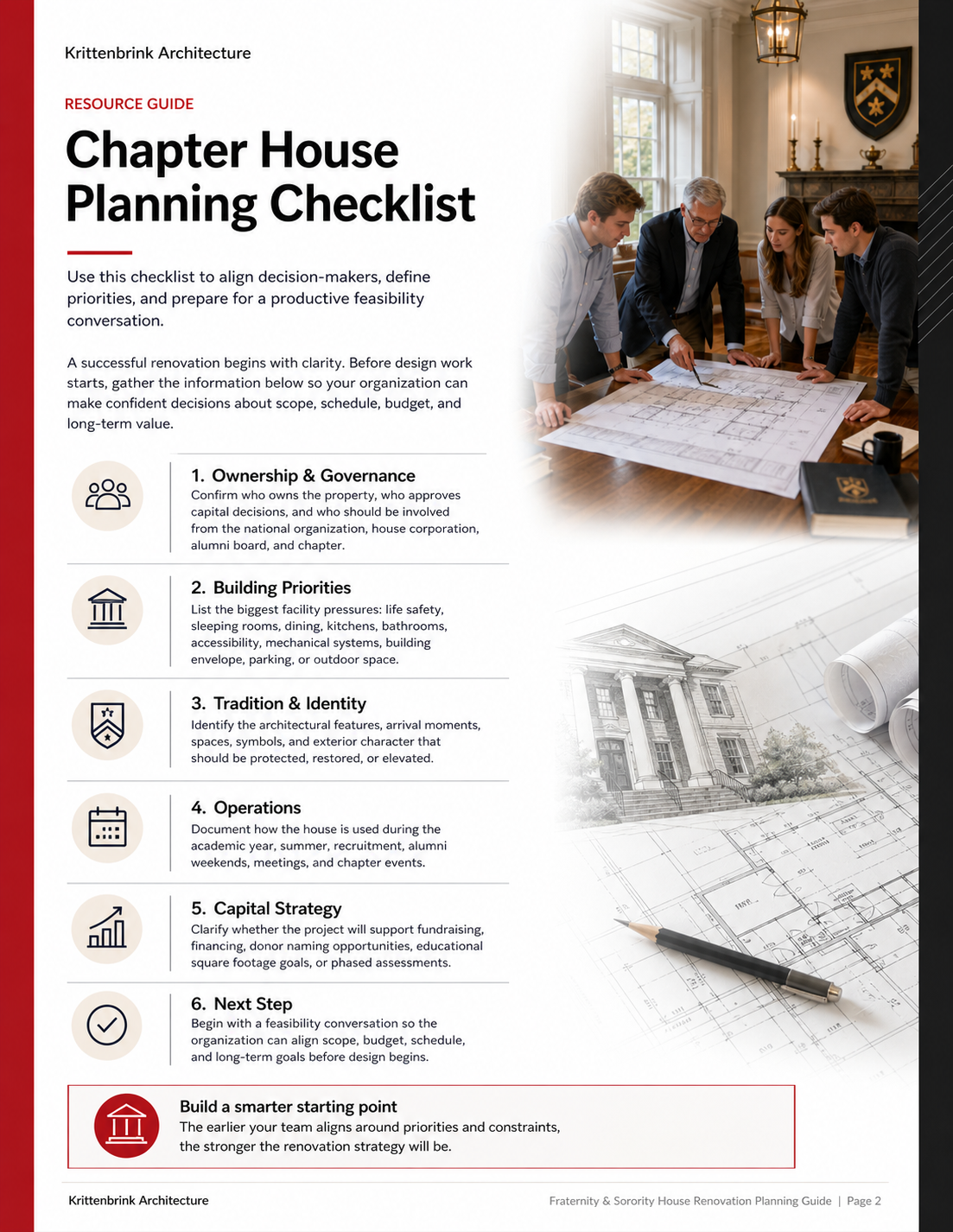
Planning a fraternity or sorority house project? Use this chapter house checklist to align leadership, priorities, operations, and capital strategy early.
A successful chapter house renovation begins long before drawings are finalized or construction pricing begins. For fraternity and sorority housing corporations, alumni boards, national organizations, and facility committees, the earliest planning conversations often determine whether a project moves forward with clarity or confusion.
Chapter houses are operational buildings, recruitment tools, alumni symbols, gathering spaces, and student homes all at once. That means planning must account for governance, tradition, daily use, capital strategy, life safety, long-term maintenance, and member experience.
This checklist is designed to help chapter house decision-makers align around the right questions before beginning a feasibility study, renovation, addition, or modernization project.
Start with Ownership and Governance
Before a chapter house project moves forward, confirm who owns the property and who has authority to approve capital decisions. This may include the national organization, local house corporation, alumni board, foundation, facility committee, chapter leadership, or university partners.
Clear governance helps prevent delays, confusion, and misaligned expectations later in the process.
Define the Building Priorities
Every chapter house has pressure points. For some, the most urgent needs are life safety, sprinklers, accessibility, roofs, HVAC, kitchens, bathrooms, or electrical systems. For others, the issue may be sleeping capacity, dining, study space, storage, laundry, parking, or outdoor gathering areas.
A strong planning process identifies what is urgent, what is strategic, and what can be phased over time.
Protect Tradition and Identity
Fraternity and sorority houses often carry deep emotional value. The front entry, formal rooms, exterior character, architectural details, symbols, rituals of arrival, and alumni memories all contribute to the identity of the house.
Good planning does not erase tradition. It identifies what should be preserved, restored, or elevated while making the building safer, stronger, and more useful for modern chapter life.
Understand How the House Operates
A chapter house is not used the same way every day of the year. It may support recruitment, chapter meetings, meals, study hours, alumni weekends, summer use, officer work, ritual, informal gathering, and daily residential life.
Before design begins, document how the house is used throughout the academic year and where the building no longer supports chapter operations.
Clarify the Capital Strategy
The strongest projects connect design decisions with capital planning. Chapter house leaders should consider whether the project may support fundraising, financing, donor naming opportunities, educational square footage goals, phased assessments, or long-term maintenance reserves.
When design, budget, schedule, and fundraising strategy are aligned early, the organization can make stronger decisions.
Begin with a Feasibility Conversation
A feasibility conversation helps align scope, budget, schedule, priorities, and long-term goals before design begins. It gives decision-makers a clearer picture of what is possible, what needs attention, and how to move forward responsibly.
The earlier your team aligns around priorities and constraints, the stronger the renovation strategy will be.
Planning a Chapter House Project?
Krittenbrink Architecture helps fraternity and sorority housing leaders evaluate feasibility, renovation, modernization, additions, and long-term chapter house planning.
Download the Chapter House Planning Checklist or contact Krittenbrink Architecture to begin a feasibility conversation.